January 17, 2008
I’m on a 19 hours long bus trip from hell from Tarapoto to Piura at the moment so I thought I’d rant! We took Sol Peruano since they were the only one with a final destination of Piura, but I think it would have been much more comfortable and faster to take Movil Tours to Chiclayo and then transfer toward Mancora from there. This bus was supposed to be a semicama, meaning almost like having a bed, but in reality is about as comfortable as your average airplane seat, even with a little less room. To top it off, it’s filled with Peruvians, who as a possibly unfair generalization, are fairly oblivious to being considerate of things like noise, garbage, and personal space. I never would have taken this bus if I had know that it would be uncomfortable, crowded, stop frequently, and have no overhead lights or curtains. At least it’s got a bathroom, one you’re only supposed to pee in, but a bathroom nonetheless. I’m sure you could get away with pooping in it though since it’s just a hole that opens directly onto the road. Fortunately I’m mostly recovered from my flu that I’m just getting over, so the bathroom isn’t as essential as it would have been a day or so ago.
Don’t think we didn’t ask a few questions before buying tickets. The problem is, people here can’t communicate about details to any useful degree. Honestly, at first I just chalked it all up to a language barrier thing, but now we’re sure we understand most people and they’re just awful at communicating. If you ask them yes or no questions, like “is it a semi-bed type bus?” they’ll almost invariably say yes whether it’s true or not. It seems like people just answer yes because they think it will make you happy to hear what you want. We have to remember to refrain from asking yes/no questions in the future. Also if you ask for descriptions of time or distance you will ALWAYS get a drastic underestimate usually with fairly vaguely infurating words. For example, ahorita is the diminuitive form of ahora which means “now”. However if someone says something will happen ahorita, it could mean anywhere from 5 minutes to tomorrow. It’s a fairly meaningless word. As is “cercita”, which means close. To say that the waterfall you’re walking to is cercita could mean it’s another 5-10 miles away. People often just guess information they don’t know, but they answer as if they did.
As I’m writing this someone is loudly puking. He could just be hocking a loogie as this is done frequently and very loudly by most everyone all the time. Earlier a little girl (adults do this sort of thing too and more often) got up and walked over to the stairs and spit ON the stairs. I never really thought that considering spitting on the floor gross could be considered differently depending on the culture. I’m hoping this puking sound is in the bathroom, but it’s hard to tell with the baby and mother behind me making never ending noise. Did I mention there’s no light so people on this double decker bus can’t see to walk down the stairs or while in the bathroom?
Of course the lights do go on every time we stop, which is close to every hour. With every stop about 5 or 6 people get on the bus to sell whatever crap they have, usually gelatin, which they try to sell by loudly announcing repeatedly what they have. This makes sleeping fairly impossible for more than a few minutes at a time.
Did I mention that there’s a small child and a gigantically fat woman with the cell phone sitting behind me? You really can’t avoid traveling with children unless you rent your own car, and that’s really not a good options considering the roads are full of crazy drivers and in terrible shape. This bus recently had to drive through a shallow stream because the bridge that goes over it is not wide enough for the bus. Many sections of the road are washed out and incredibly bumpy. They are doing a lot of construction to improve the roads, but construction here goes oh so slowly because so much work is done by groups of men with shovels. Imagine trying to create mountain passes through the Andes with hand tools and it’s fairly obvious why it takes so long. The roads are frequently shared by all types of transport moving at all speeds: motorcycles, double decker buses, cars, semi-trucks, farm trucks, horses, donkeys and people walking.
The adults on trips can often be much worse than the children though. It’s like a bad Saturday Night Live skit where people can’t control the volume of their voice. There’s also people with this lovely new cellphone technology and I think everyone here is still in the mindset that you have to talk much louder on the phone than you ever do in person. There’s definitely people like this in the US too, but I swear there’s more here and the biggest thing is nobody local ever asks them to shutup. In the US if you’re one of those people sooner or later somebody will ask you to shut the hell up and everyone will applaud or something. Here nobody says anything, even if they’re annoyed , and we’ve met a few people who are annoyed, and say all their fellow countrymen have bad manners. If we ask these people to be quiet they ignore us or laugh since we’re foreigners. People just don’t seem to demand in any way that those around them behave well. People just seem to put up with everything, and I’m often unsure if they’re oblivious or just unwilling to confront anyone.
Another habit people have that nobody ever says anything about is throwing garbage out this windows. Everything goes out the window while you’re driving. This applies during long distance bus trips and in the cities in taxis. Plastic bottles, empty beverage containers, candy wrappers, dirty diapers, food scraps and more just get tossed whenever you’re done with them. I think people expect that someone who works for the government should clean it up. However, even if they stopped littering in some places and put stuff in trash cans, the garbage just gets hauled to be dumped in the local river anyway. This is what they did in Leymebamba anyway and I’m sure most other small towns. I’m not sure what they do with garbage in the larger cities, but whatever they do there’s plenty of it in the streets. Sometimes I think they just dump it in abandoned lots.
At least one thing they DON’T have on this hell trip is blaringly loud cumbia music. They did play cumbia for a few hours but I don’t think they could get it loud enough so gave up on it. Someone in Huanchaco the first week we were here said they only thing that matters to a Peruvian when buying a stereo is how loud will it go, and then I thought that seemed an unfair generalization – now I don’t. They have speakers wired up here, but no lights. If you haven’t heard a lot of latin american music before, you probably won’t be able to tell cumbia from salsa (cumbia usually has a rhythm more like a horse’s clip-clop-clip). Either way, salsa or cumbia, it’s not something I would consider worthy of listening to for 5 hours straight, especially since they there’s a group here called “Grupo 5″ that is so popular I think most people really do just listen to them for 5 hours on repeat.
Phew, I’m finally off that bus. I actually managed to sleep for a few hours despite the crowing rooster someone carried on. Of course it took longer than expected, something just short of 21 hours. We’re now sitting in another bus terminal in Sullana, which really doesn’t look like it has anything interesting, waiting to catch another bus to Mancora. From here on out we should start seeing a lot more foreign tourists, which I’m actually quite ready for. Being around almost exclusively Peruvians for the last month and half has definitely shown me I could never live comfortably among them. I don’t think I mentioned staring. There’s two little boys who are just staring at me as I write this. Children and adults do this equally and nobody seems to think it rude, and asking them to stop usually only works for a few seconds before they’re back to just openly staring. They’ll stare even if we’re just sitting still, reading a book, even in areas where I know they see a lot of tourists.
OK, that’s enough for now. I could probably go on, but I’m exhausted and fed up. Hopefully the world looks better after a decent sleep.
January 12, 2008
Leaving Leymebamba and heading into the jungle we thankfully didn’t have to spend much time in Chachapoyas. It was Sunday so the highway wasn’t closed between Chachapoyas and Pedro Ruiz, but we did have to take a LOT of different shared cars and do a little stint in Chacha. Our journey went Leymembamba to Yerbabuena to Chachapoyas to Pedro Ruiz to Nueva Cajamarca to Moyobamba.
We spent a few days in Moyobamba enjoying being back in a city where you can buy more types of food than potatoes and rice. We found some pretty good vegetarian Lasagna at La Olla de Barro. We also saw the miradores, which are lookout points to see the muddy river that winds into the rain forest. We also saw a really cool orquidium that had something like 400 species including four that the owner had named himself. Nearby we went to the hot springs, which were pretty nice since they were pools outside, but the water wasn’t that hot and you’re sharing the pools with all the local families blasting cumbia music.
The highlight of sites around Moyobamba was the waterfalls in Lahuarpia. About a half hour out of Moyobamba there’s a little trail out of the village that’s actually well maintained, with garbage cans and a bathroom, that leads to three waterfalls that you can swim in. There’s even signage about the local animals and plants. Apparently not many travelers make it here, which for now makes it even nicer as we had the whole place to ourselves. We could have spent more time there, but we got there in the afternoon and didn’t leave until dark.
From there we wanted to head directly to Tarapoto, but after dark it’s hard to pick up transport, so we went back to Moyobamba and then to Tarapoto. We’ve been in Tarapoto a few days now and been pretty lazy, which has been nice. One weird thing about these hostals in the jungle is even the cheapest ones have cable TV’s. Most don’t have hot water, but TV’s are essential. We’ve been watching sitcoms in English more than we should because of this. Every night we eat pizza from a place called Cafe d’Mundo that’s AMAZING. It’s not the best in the world, but after some of the food people here try to pass for Italian food, it seems like it. The coolest thing we’ve done here was rent a moto scooter for a few hours and ride around the city. It’s a rush getting around in traffic here. There really are almost no rules, but everyone seems to be paying attention pretty well, so once you get used to it there’s a flow to it.
Unfortunately now I’m a bit sick with the flu. We’re in a nice hostel watching movies to pass the time and I just found out there’s wireless internet. We’ll see how I feel tomorrow and from there either do some more touristy stuff in the area or head to the coast for some fun and sun. Something interesting about all the cheap hostels here is they have cable TV, even if they don’t have hot water. I just thought of that because tonight we splurged, and got one with hot water.
January 6, 2008
Before leaving Leymebamba we went on a three day trip to the Laguna de los Condores. It was really an adventure. We went with Stephanie and Elena, so both our guides were women, something the men in town seemed concerned about. It was about 11 hours on horseback and hiking to get there. This included lots of treacherous rock slopes, swamps where the horses sank up to their bellies, drenching rain for hours and a 12,000 ft mountain pass. Kim got a little altitude sickness at the pass, and we arrived at the cabin drenched and tired. One of the nice things about arriving in all the rain is the surprising quantity of waterfalls all around the valley. I didn’t take any pictures of them though because it was raining too hard!
The cabin is pretty basic with no running water or electricity. The cooking is done over a wood fire as well as the drying of clothes. The land around the cabin is used for cattle. You can’t see the lagoon from the cabin, but it’s not far to where you can see it. It gets really cold at night so we slept with our small sleeping bags and a couple of blankets each.
The next day we woke up early and waited for the rain to subside a bit as it was pouring. Fortunately as we set off for the hike to the mausoleum’s on the cliffs above the lagoon, the sun actually poked out for a bit. The hike to the mausoleum’s actually makes you feel like you’re in the jungle, which I guess technically you are. To get to the cliffs there was a lot of ladders to climb and we walked through a few small waterfalls. There’s a few skulls left over in the houses built into the cliffs, but most of the remains have been moved to the museum in Leymebamba. I don’t know how anyone ever found these cliff tombs or why the Chachapoyas built them where they did.
Going back was a quicker trip (maybe 9 hours?) since it didn’t rain as much and Kim breezed over the pass thanks to chewing coca leaves, drinking some booze and eating chocolate. There were some exciting parts where the horses sank into the mud really deep, but they got out after a lot of shouting at them. We arrived back at our lodging in town dirty and tired, so thank goodness there was running water for a shower when we got back.
We met the new volunteer the next day and gave her the info she needed to continue the classes. We said all our goodbyes and left the next morning.
December 29, 2007
The month in Leymebamba has been a tranquil one. There’s been a lot of free time and the last few days Kim and I have begun to discuss what we’ll do when we return to the US. I think this is the first time in my life that my options have seemed so open ended to me. I’ve definitely decided that I don’t want to go back to a traditional office job. So I’m just going to muse on the future options that we’re considering.
One of the most serious options is starting my own company. I want to create software, and I already have an idea that I’ve been working on a bit. Much of the influence for this idea came from reading the essays of Paul Graham. I believe that the idea of a typical job will change a great deal in the near future as the tools to create things of value to others become so much better, but so much more complex. Those who can use these tools and provide something of value will be compensated according to the value instead of just how many hours they work. It’s already this way for those who are willing to take the risk, but the risk is becoming much less as access to these tools become so much less expensive. Anyway, once of the barriers to this idea is much research indicates that having a partner greatly increases the chances of success, and I’m not sure I’ll find a partner. I have a few friends that I’ve approached with the idea, but I’m dubious that when the time comes they’ll be willing to make any commitment to the idea.
Therefore another idea is to return to school for an advanced degree. Since leaving school the more study I’ve done into computer science the more I’ve wanted to know. I’ve missed the environment of school. What’s more, I might meet fellow grad students that would be interested in some starting some sort of company. One major problem with this idea is that we don’t know where we’re going to live. We don’t know if we’ll find a place to live first and then decide what to do or vice versa, and if there’s no good schools for computer science, why bother going back. I haven’t looked into online universities though.
Another new idea is to continue this vagabond life without home and hike the Appalachian Trail. We’re already without a job or home to worry about, and getting to that point in decent financial shape is quite a bit of work. So while we have that would be a great time to take advantage and take some months to do something like this, that I’ve always wanted to do. A problem with this is that we’re already feeling a little homesick and missing creature comforts. And it could be a little expensive.
Of course, we could decide to keep on traveling through Latin America. It really is cheap compared to living back home, and our house is probably appreciating faster than we’re spending money here, so even though we’re not earning any money, in theory our net worth is going up. Right now we’re both leaning toward coming back in mid April, but we could change our minds once we head to other countries. Right now the general plan is to head south to Arequipa, then through Bolivia, and then to Argentina. We had considered going to the jungle, but since it’s the rainy season in the highlands in the jungle until around May, we’re thinking going south to get a nice summer in the southern hemisphere might be more pleasant. We still want to go to the jungle at some point, but we might do it in Bolivia or when we come back north from Argentina and Chile.
Having all these options to consider is both exciting/fun and a little scary. Before there’s always been the next year of school to look forward to or a job after graduating. School and job are still options, but not in the same certain way they were before. Kim and I both definitely miss having a routine and schedule to our lives, but I don’t think either of us want to fall into a stale routine. I think the excitement and fun of exploring something new usually outweighs the fear of risk.
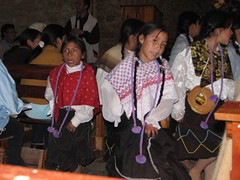
Pastores singing and dancing in church
This was my first Christmas away from home. I definitely missed being home with family. It just didn’t feel like Christmas here. No snow, no Christmas tree, no family dinner, weird food, most stores didn’t close, no gift giving and few feelings of familiarity. I think some of these feelings of familiarity are my favorite parts of the holidays. I really wanted a group of people to speak English with.
Not that it was a bad Christmas, just not like home. Christmas Eve was actually when most of the action happened. The day was very quiet and the people we’re staying with don’t seem to have family gatherings. They spent most of the day working on the construction of the new part of their house. There was talk of a shared dinner, but nobody seemed to make it happen, so in the evening we just drank hot chocolate with cheese. Weird combo, huh? And the hot chocolate here isn’t like Swiss Miss. It’s straight from the cocao beans, so it’s really weird and oily. Oh, and paneton which is essentially fruit cake but light and fluffy. It’s pretty gross in my opinion, but it’s a huge deal here. I taught class at night. I didn’t think sutdents would want class at 8 on Christmas Eve, but they did and I had free time so why night. Afterwards we went to church. It started like the same old boring Catholic ceremony, but at the end there were children who sang and danced what sounded like traditional songs. After church they go from house to house to visit people’s nativity scenes and do their songs and dances there. This all takes place after midnight.
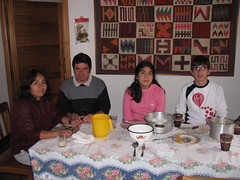
Lily, Maibel, Carmen y Arnold our host family for Christmas day lunch
Christmas day was a nonevent really. There were a lot of people hung over in the streets the next day. We heard that the discotech was even open the previous night. Weird. Just not Christmasy. We had lunch with a family, but it’s not like there was any tradition or anything out the ordinary. Kim has a much more complete description, but really Christmas just didn’t feel like a big deal here.
Other than that the last few weeks have been quiet. It rained last weekend so we didn’t go anywhere. We didn’t watch TV at all for the first 3 weeks, but lately we have. A few movies and the Simpsons in Spanish mostly. The children have left for their “summer” vacation, so we don’t have classes in the morning anymore. Besides that I haven’t had any students show up to the evening classes in more than a week. I really has begun to annoy me a great deal how flaky people are here about being at places when they say they will. You wouldn’t believe how many people say, “I’ll definitely be there!” and then don’t show up. Even the people we live with sometimes say they’re going to class, even 15 minutes before class, and then don’t go. It’s like the more certain people sound when they say they’ll do something, the less likely it is. But what can you do? It’s the culture and they just don’t seem to notice when everyone is late or doesn’t show up. At least the children have been showing up to a new afternoon class that we’ve started. We’ll see how many continue to show up conistently.
One of the few things we want to do before heading back is go on a horseback trip to the Laguna de Los Condores. I think this will depend a lot on the weather though. Aside from this, I’m looking forward to getting back on the road again. A month with too much free time turns out to be a little too much for me. I’ve actually at times felt bored, something I don’t think I’d felt almost at all in the last few years. As soon as I’ve felt bored I’ve found something to do, but it’s not what I’d be doing if I was back home in my spare time.
December 16, 2007
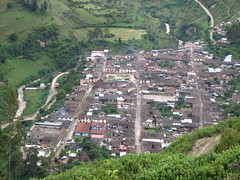
Leymebamba Viewed From the Museum Trail
Two weeks have passed fairly quickly in this quiet little mountain town. We’ve been plenty busy teaching English. When we arrived there were only about 10 hours of class a week for each of us, mostly for adults that have major attendence problems, to the point that some nights only one of us teaches the few students who attend. That’s far too much free time in a town this small. We already had too much downtime at the farm in Ecuador, so here we wanted to be busy and involved, so we started teaching at the local schools.
Every week day we’re teaching an hour at the grade school and a half hour at the preschool. We’ve rediscovered a few of our childhood songs for teaching purposes like “Head, Shoulders, Knees and Toes”. Classic and perfect for little kids who would much rather move than memorize. We’ve got songs for days of the week and colors too. We also started another afternoon class for kids who want to come.
Pronunciation really is difficult for Spanish speakers since there’s so many sounds they just don’t have in their language. I’ve spent HOURS trying to teach people to make a “th” sound. I’m teaching to all beginners, every class, so I’ve been going over basics like numbers, days of the week, greetings, etc a LOT. Kim has the only advanced class and she’s liking it, so that’s cool.
The weather has been mostly sunny and the scenery around here is gorgeous. We’re in a valley with a pretty river and green mountains all around. I think the rain is even pretty and I’ve actually enjoyed the rainy days when they come since it rains hard and washes everything. We’re techinically in “winter” now, but they only have two seasons here, and they’re really just the rainy season, which they call winter, and the not rainy season, aka summer. It hasn’t been too rainy for us though so far.
We’ve gone to the museum which has a bunch of mummies that they discovered on the land of the family we’re staying with. There’s dozens and dozens of ruins and discoveries of past civilizations in the area. They’ve only really just begun to develop this area for tourism. The problem with most of the sites for tourism is that they’re hard to get to. The Laguna de Condores, where they discovered the museum mummies, is a three day trip from Leymebamba, and getting to Leymebamba is no day trip either. It’s 3 or more hours down a bumpy dirt road from the nearest “city”, Chachapoyas, which is only accessible right now by a highway that’s under construction so that it’s passable only at night. They’re improving the roads though, even if slowly, and I think that will make all the difference in developing the region.
We also went to Kuelap which is an ancient Chachapoyan (people of the clouds) fortress that supposedly rivals Machu Pichu for grandeur. We definitely liked it. We hiked to it instead of taking a car since we didn’t know the schedule and might have had to wait for hours for a car to get there. The hike was a little over four hours of all uphill. We climbed a little under 4000 feet in that time. I think the downhill was harder though since we were already tired and downhill is so much harder on joints.
I’ve been reading Isaac Asimov’s Foundation books and playing some old Nintendo games in my down time. I was definitely going through video game withdrawal for awhile. I realllllllly missed playing video games, but the laptop I have with me really isn’t fast enough for many games and downloading anything from here would take forever with the slow connection. Then I remembered you can download Nintendo emulators and the game files are tiny, so I’m playing some of my old Super Nintendo favorites. That’s actually a big help when I start feeling homesick.
Aside from school Kim’s been cooking a lot. The family we’re living with includes a couple close to our age, Omer and Estefani, and Estefani wants to learn to cook some of our favorite foods since they’re opening a tourist restaurant in a few months. There’s kitchen so it’s great that we have space to cook our own stuff since we’re in general NOT big fans of Peruvian food. I’ll rant about that later.
Julio and Wilma are Omer’s parents and the owners of the hostal, and there’s a child, Omer Jr, who is going through a bratty phase right now. It’s nice living with a family and still having plenty of our own space and downtime. Although I’m a little jealous of the previous volunteers who were in a different hostal that was quite a bit more modern with a washer, private bathrooms, and windows in the rooms. We have a shared bathroom here with one of those damnable electric water heaters that scare me to death and only warm a little water at a time. Our room has a balcony which is cool, but there’s no windows, just the wooden doors to the balcony, which we don’t really want to leave open at night, so in the morning when we wake up it’s pitch dark no matter what time we wake up.
I’ve really begun to realize how great a lot of the appliances and utilities we have back home are. We washed our clothes by hand today and that just sucks. It’s so much less efficient than a washer. I don’t mind hand drying clothes as it’s fairly easy, not messy and uses less energy, but washing by hand is not efficient at all for the water usage. I also really miss reliable water. A lot. I can’t wait to get home and turn the tap and have hot water, drinkable water, and have it all the time! We haven’t had running water all day. When we do have water we have to let the dirt in it settle, then pour it in a pot and boil it. The water comes from the local river and the sewage gets pumped right back into that same river. The power goes out frequently. In fact it was just out for five minutes as I write this. They have internet and phone in the village via satellite so phone calls are expensive and internet is slow. Amazingly Skype works, so we can use that to call home cheap, even it is a little laggy. They have 3 telephones in the town, so if you want to call someone here from another city, you call, someone answers, you tell them who you want to talk to and hang up. Then you call back in 10 or so minutes and hope the person could be found and came to the phone.
So far it’s a great experience and the people are famously friendly. There’s much less noise and traffic than where we were before, which is amazingly nice. The students when they do show up are eager and grateful. I want to emphasize that I like it here, because I’ve been writing a lot about things that I miss and am about to talk about some cultural differnces. It’s just that differences and stuff that I miss is more interesting to read about than me going on about how pretty the countryside is. Besides, living without the conveniences and at a slower pace of life helps you appreciate what you have in the US when you return.
As I’m sure I’ve mentioned before about South America in general, the pace of life is much slower. People say they’ll do something at 1, which really means that they might show up at 1:30, maybe 2. Sometimes not at all. We’ve met a ton of people who say they’d like to go to English classes and that they WILL be there. They never show up. Many of our students who do show up for the 8 o’clock class show up at 8:30.
There’s no one grocery store here. There’s about a dozen very small shops though that all have close to the same stuff. However, if you want something other than rice, potatoes and onions you might have to go to 3 or 4 stores before you find what you want. We’re amazed at how few vegetables people eat here, excluding potatoes of course. I think they eat more rice than in China too. It sounds to me like people have lost a lot of the healthy eating habits that their ancestors had living off the land. Most meals consist of rice, potatoes, some meat and a lot of salt. Fortunately there’s one restaurant in town where the owner is one of our students, and the couple before us were vegetarian also, so the owner knows how to cook for us.
Phew, if you read that much congratulations. I’m sure the next two weeks will pass just as quickly if not more so. The children we teach are going on their “summer” vacation until march though, so we may soon have few classes. But with Christmas and New Years come up I’m sure there will be festivities to keep everyone busy. After Leymebamba we may head to the jungle, we may head to Argentina. Who knows. I’m leaning toward Argentina right now though as I hear it’s more modern and still really cheap. Plans always change though.
December 1, 2007
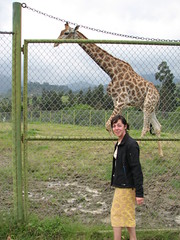
Kim looking short
We spent the afternoon in Loja before heading back to Peru. There’s not too much to do in the city, but it’s a nice little city. We went to the zoo there which is fairly new. Not to say it’s up to any kind of standards of American zoos, but it’s better than we expected. We got to see a spectacled bear, which is endangered in the region and very rare to see in the wild. A guide on a hike said he’d only seen two in 30 years. The monkeys are always fun to watch too.
From Loja we had an overnight bus that went straight across the border to Peru, stopping for immigration, and on to Piura. Much simpler than the other border crossing even if less exciting. We spent a few hours in Piura and that was more than enough. From there we were on to Chiclayo. I was extremely frustrated by the food options in Chiclayo.
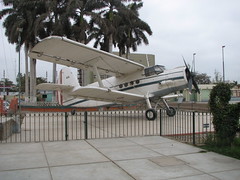
Peru’s Airforce in Chiclayo
I hope to never see another polleria (basically fried chicken) restaurant again. We finally found a vegetarian restaurant by jumping in a cab and asking since the directions some people gave us were utterly useless and there were none listed in the guide book. We went to three movies to pass the time in evening: Beowulf (thumbs up), Next (thumbs down), and Mr Brooks (neutral – good in a way, but super weird).
The highlight of Chiclayo was definitely the museum, Señor de Sipan, which is actually in Lambeyeque. This is the best museum we’ve seen so far. We must have spent over 4 hours there. By the time we got out we didn’t have to see anything else as our bus left at 7PM. We got a semi-cama with one of the nicer bus companies, Movil Tours, which means the seat goes almost horizontal and they don’t blast action movies all night long.
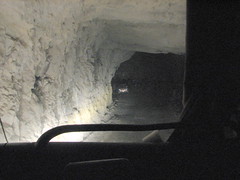
Crazy Road Back to Chiclayo
This makes night buses soooo much better. We also got the very front seat too, which is cool because you have a view right out the windshield to see the scenery and there’s nobody in front or behind you.
We got stuck for a few hours again in Chachapoyas, which I don’t think I’ll ever enjoy too much, but now we’re in Leymebamba for the month of December to teach English. It’ll be nice to be somewhere small and friendly for Christmas if we aren’t going to be at home.
November 29, 2007
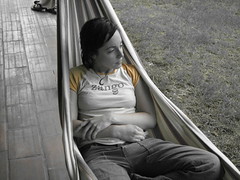
Kim hammock chillin
Vilcabamba proved to be a lovely place to relax for a few weeks. It’s quite a bit more expensive than Peru had been, partly because they use the US dollar for currency, but mostly because of all the foreigners living there. It’s still much cheaper than living back home. Where in the US can you get an amazing massage for $10/hour?
We spent a few nights at El Jardin Escondido, which is probably the nicest moderately priced hostal ($22 for two people) close to the center. It’s run by a Canadian I think is named Marcel. That’s where I got my first massage from a woman named Piedad. There’s a ton and a half of massage places, but we were told by a few people that Piedad was one of the best, including Piedad herself. It’s a Swedish massage style, which I normally don’t care too much for, but she’s strong so it’s good. Besides the massage I swam in the pool, chilled in the hot tub, relished eating decent Mexican food and good bread again and finished reading Catch 22 again.
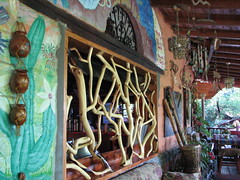
Cool Window at Madre Tierra
After roughing at the moderate priced place we decided to spring for what we had heard was true luxury – Madre Tierra. It definitely is luxurious and beautiful, but we were more than a little annoyed at the terrible communication at the reception desk. We got there and nobody could tell us prices for rooms. Apparently only one person at a time knows the prices and she was out of town for a few hours. You’d think they’d have a price list. Some guy brought us to a room and told us it was $30 a night. We figured that wasn’t too bad so we set our stuff down. Then we clarified and found out it was $30 per person. Finally after threatening to leave they offered to let us have a room for $20 a night – per person of course. Not the one they first showed us though. It was pouring rain and we had to see what this place was about so we stayed. At the end their credit card machine didn’t work and they said that they hadn’t included IVA (tax) in the original price. I think everyone else includes IVA in their price, so I was pretty fed up by this point. Anyway, onto the good parts.
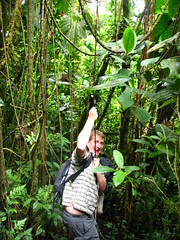
Swinging from a Jungle Vine
The stay includes breakfast and dinner, which were very good. We did a spa treatment that lasted 5 hours and was $45. That included a facial, a steam treatment, a salt scrub, a mud bath, a foot and head massage and probably something else that I’ve forgotten by now. We were in there being pampered for a LONG time. We came out very relaxed – until trying to check out and dealing with the reception desk…
We also quickly undid all the relaxing by heading to the Neverland farm, which I’ve broken out to a separate post. After returning from the farm we spent a few nights at a hostal out of town a couple kilometers called Izhcayluma. This was my favorite place overall. It has an awesome view, beautiful buildings and a terrific atmosphere. The atmosphere is mostly due to all the cool travelers you meet there. Adventurous, crazy, interesting travelers seem to congregate there, and the onsite bar makes for some hilarious and fascinating conversations. One Scottish guy kept offering people $100 to bring back the ears of robbers who have been plaguing some of the local hiking trails. A lot of the staff is volunteers from European countries, so the service is way better than with local running things, sadly.
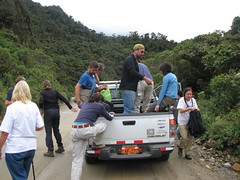
Piling into a pickup to go for a hike
We went on a hike with a local guide whose name I don’t remember to Podocarpus National Park one day. It was a very pretty hike, but nothing spectacular. The ride there was notable due to riding in the back of a pickup through very pretty scenery. That night we stayed at a cheap hostal ($5 per person) in the center to be close the next morning to leave on our horseback trip with Gavin, which was a blast. That’s also a separate blog post.
Once we got back from the horseback trip we spent a night at another hostal run by some French. Funny how all the interesting hostals are run by foreigners. We also both got another massage. This one was from the lady at Shanta’s bar whose name I forget and she does a lot of physical therapy type stuff where she makes your body crack in all sorts of ways I’ve never experienced before. By the last night we noticed that we knew a ton of the people walking around the central plaza, especially after talking with Gavin. The town was starting to feel a little too small and weird once we knew enough about the crazy foreigners living there. Fortunately we we’re on our way back to peru now.
November 26, 2007
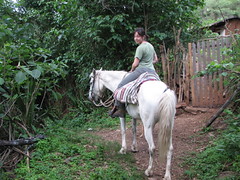
Kim Horsing Around
Kim found a farm project called the Neverland Farm on the Wwoof website that sounded interesting with agro-something-intersting and sustainable-blah-blah so we thought that we’d check it out. It didn’t turn out to be quite what we expected. It was an interesting experience, but unfortunately we didn’t think it was nearly as amazing as other reviews from volunteers.
To start, the lady who runs the farm, an American woman named Tina, wasn’t there while we were. She had to go back to the US to deal with family problems. There also weren’t any other volunteers. Therefore the remaining people on the farm were all Ecuadorian and weren’t as organized as we had hoped. Angel, aka Killo, seemed to be in charge of the running of the farm, even though he was there only a little over half the time. His brother Pio had only been there about a week so really didn’t know much. They were the only two people besides us who ever spent the night there. During the day Andres came from the nearby village of Tumianuma to work. Nobody talked much without prodding and everybody left a lot. They were all nice enough, but we were hoping for a more social atmosphere.
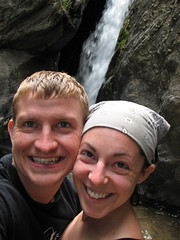
Us Near a Waterfall We Hiked To
We went to the farm with the intention of learning a little about gardening, sustainable living, or novel construction, but we found ourselves a bit bored. Whenever we asked what we could do to help we were told we could do whatever we like. However, we didn’t even know where the main garden was until our third day on the farm, let alone what kinds of projects would actually be helpful. We ended up cooking a lot, mostly for ourselves, weeding, and I went out hacking stuck with a machete which is fun (I feel kinda like Indiana Jones), but dangerous – I cut my shin when I lost my grip on spring tree branch. One of the first days we carried rocks to help make a wall for a new house, but we never went back to that project. We were hoping the pregnant horse would have her baby while we were there, but no such luck. I rode the other horse a little bit for trips back and forth to the nearest little pueblo, Tumianuma.
Mostly we read a lot. I read a few books from the Dahli Lama which were quite interesting. Buddhism really interests me – until you get into some of the weirder details. We also hiked a bit up the valley to a little waterfall. There was a guitar I got out to play a few nights. Other than that it was pretty slow.
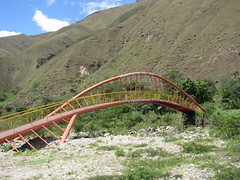
The bridge on the way to the farm
Sleeping was a little difficult since our bed was dreafully uncomfortable. It was a very thin mattress on top of a bamboo frame. Two nights Angel was gone we slept in his bed and it was insanely more comfortable, but didn’t have a mosquito net on it. The bugs weren’t too bad while we were sleeping though. Just while we ate. Ugh. Don’t wanna remember that.
At the end of the week Killo asked us to pay $25 per person for food, which pissed us off a bit since we were told before we arrived there was no cost except bringing in some food, which we did (about $20 worth), since we were working 4 our more hours a day. There’s a sign on the kitchen that says $15 a week is suggested, so we paid that as it seems somewhat fair, but we’re still just angry about the lack of communication about it all. Overall we were quite happy to be leaving, but it was definitely an intersting experience for a week. Not that I’d choose to do it again – at least not without Tina there.
November 21, 2007
Kim and I just got back to civilization after being on a farm in Ecuador near Vilcabamba without any form of communication for the past week. Just wanted to let everyone know I’m still alive and will be posting more details on what I’ve been up to later. For now, I’m just enjoying electricity, soft beds and toilets with water again. The last few weeks have been kinda hectic as the plans changed and we spent a bit of time on the road to adjust. It’s relaxing time. I’m going to get a $15, 90 minute massage this evening. Then… pizza. I’ve missed civilization.